
Writing clearly is one of the most important skills any writer can develop. Whether you are writing a blog post, an academic paper, a business document, or a novel, the way you structure your sentences affects how readers understand your message. One common concept that often confuses writers is the difference between active and passive voice.
Many people hear about active and passive voice in school but never fully understand how they work or when to use them. Learning the difference between active and passive voice can immediately improve clarity, readability, and confidence in your writing.
In this article, we will explore the difference between active and passive voice, explain how to identify each one, and show you when to use them effectively.
What Is Active Voice?
Active voice is a sentence structure where the subject performs the action of the verb. In simple terms, the subject does something.
For example:
- The writer edited the article.
- The teacher explained the lesson.
- The company launched a new product.
In each of these sentences, the subject performs the action. Understanding the difference between active and passive voice starts with recognizing this clear structure: subject first, action second, object last.
Active voice is usually preferred because it is direct and easy to understand. When writers understand the difference between active and passive voice, they often realize that active sentences feel stronger and more engaging.
What Is Passive Voice?
Passive voice is different. In passive sentences, the subject receives the action rather than performing it.
For example:
- The article was edited by the writer.
- The lesson was explained by the teacher.
- A new product was launched by the company.
Here, the action happens to the subject. Recognizing this shift is essential for understanding the difference between active and passive voice.
Passive voice often includes forms of the verb “to be,” such as was, were, is, or been, followed by a past participle. Writers who understand the difference between active and passive voice can quickly spot these patterns and decide whether the sentence works well.
A Simple Way to See the Difference
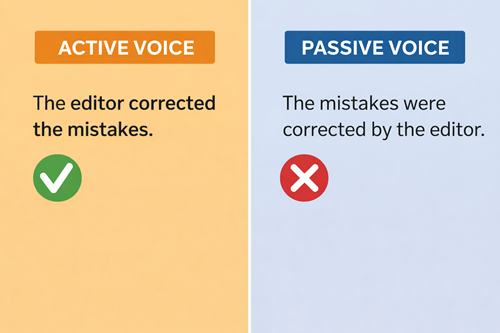
One of the easiest ways to learn the difference between active and passive voice is to compare two sentences.
Active voice:
The editor corrected the mistakes.
Passive voice:
The mistakes were corrected by the editor.
Both sentences communicate the same information, but they feel different. When writers understand the difference between active and passive voice, they notice that active voice usually sounds more natural and straightforward.
Why Active Voice Is Often Better
Many writing guides encourage the active voice because it improves clarity. When writers understand the difference between active and passive voice, they can see why active voice is often preferred.
Active voice offers several benefits:
Clarity
Readers immediately know who is performing the action.
Stronger tone
Active sentences feel confident and decisive.
Better flow
Active voice typically uses fewer words.
Understanding the difference between active and passive voice helps writers make their writing more engaging and easier to follow.
For example:
Passive:
The report was written by the manager.
Active:
The manager wrote the report.
The second sentence is shorter and clearer. Writers who understand the difference between active and passive voice naturally choose structures that keep readers interested.
When Passive Voice Is Useful
Although active voice is usually recommended, passive voice is not always wrong. In some situations, passive voice works better.
Understanding the difference between active and passive voice also means knowing when passive voice makes sense.
Passive voice can be useful when:
The doer of the action is unknown
Example:
The window was broken during the night.
The action is more important than the actor
Example:
The law was passed in 2022.
The focus is on the result
Example:
The experiment was conducted under strict conditions.
In these cases, understanding the difference between active and passive voice allows writers to choose the structure that best fits their message.
How to Identify Passive Voice
Many writers struggle to identify passive sentences. Learning the difference between active and passive voice becomes easier once you know what to look for.
Here are some clues that a sentence may be passive:
- A form of the verb “to be” appears in the sentence.
- The main verb is in past participle form.
- The sentence may include the word “by.”
For example:
The proposal was approved by the committee.
When writers understand the difference between active and passive voice, they can quickly recognize this structure and decide whether to revise the sentence.
How to Convert Passive Voice to Active Voice
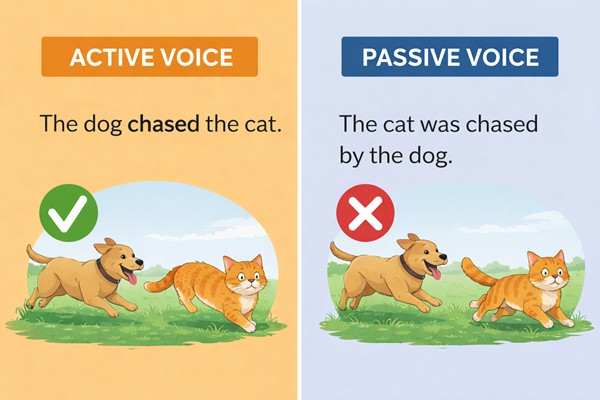
Another important part of understanding the difference between active and passive voice is learning how to change one into the other.
The process is simple:
- Identify the action in the sentence.
- Identify who performed the action.
- Place the actor at the beginning of the sentence.
Example:
Passive:
The project was completed by the team.
Active:
The team completed the project.
Writers who master the difference between active and passive voice gain greater control over their sentences and writing style.
Common Mistakes Writers Make
Many writers accidentally overuse passive voice. This usually happens because they do not fully understand the difference between active and passive voice.
Common mistakes include:
Avoiding responsibility
Example:
Mistakes were made.
Using unnecessary words
Example:
The decision was made by the committee.
Writing indirect sentences
Example:
The proposal was reviewed by the manager.
Writers who understand the difference between active and passive voice can revise these sentences to make them clearer and more direct.
Why Writers Should Care
Some writers believe voice does not matter, but learning the difference between active and passive voice can significantly improve writing quality.
Readers appreciate writing that is:
- Clear
- Direct
- Easy to understand
Understanding the difference between active and passive voice helps writers achieve these goals.
Strong writing is not only about grammar. It is about communication. Writers who understand the difference between active and passive voice are better able to guide readers through their ideas.
Final Thoughts
Learning the difference between active and passive voice is one of the simplest ways to strengthen your writing. Active voice helps make sentences clear and engaging, while passive voice can be useful in specific situations.
The key is balance. Writers who truly understand the difference between active and passive voice know when to use each structure effectively.
If you want your writing to feel more confident, more readable, and more professional, start paying attention to the difference between active and passive voice in your sentences. With practice, you will notice the improvement in both your writing and your readers’ understanding.